A quiet ADU can feel like a true home. A noisy one can feel temporary, even when the finishes look great. Soundproof ADU walls help protect privacy between a main house and an accessory dwelling unit, especially when the two spaces share a wall, ceiling, garage, or utility area.
For homeowners planning an ADU for family, guests, or rental income, noise control should be part of the construction plan from the start. It is much easier and more cost-effective to build the right wall assembly before drywall goes up than to correct sound problems after someone moves in.
Start With the Type of Noise You Need to Control
Not every sound problem has the same fix. Airborne noise includes conversations, television audio, barking dogs, music, and traffic. This noise travels through openings, thin materials, and poorly sealed wall cavities.
Impact noise comes from physical movement. Footsteps, dropped items, slamming doors, and moving furniture can travel through framing. If the ADU is above a garage, below another living space, or attached to the main home, impact noise often needs as much attention as voices and TV sound.
The location of the ADU matters too. A detached backyard unit may need sound control from a busy Los Angeles street, neighboring yards, or mechanical equipment. An attached ADU needs stronger separation from the main house. A garage conversion may require a careful look at shared walls, the ceiling assembly, and the door between the garage and living areas.
How Soundproof ADU Walls Actually Work
Effective sound control does not come from one product alone. Soundproof ADU walls work best when several details work together: mass, insulation, separation, and airtight sealing.
Add Mass to Block Airborne Sound
Heavier wall surfaces make it harder for sound to pass through. A standard layer of drywall can be adequate for some interior walls, but a shared ADU wall often benefits from additional mass. This may include two layers of drywall, sound-rated drywall, or a specialty damping compound installed between drywall layers.
More drywall does add material and labor cost. It can also affect trim details, outlet box depth, and door jamb sizing. Still, it is often one of the most practical upgrades when privacy is a priority.
Fill the Wall Cavity With the Right Insulation
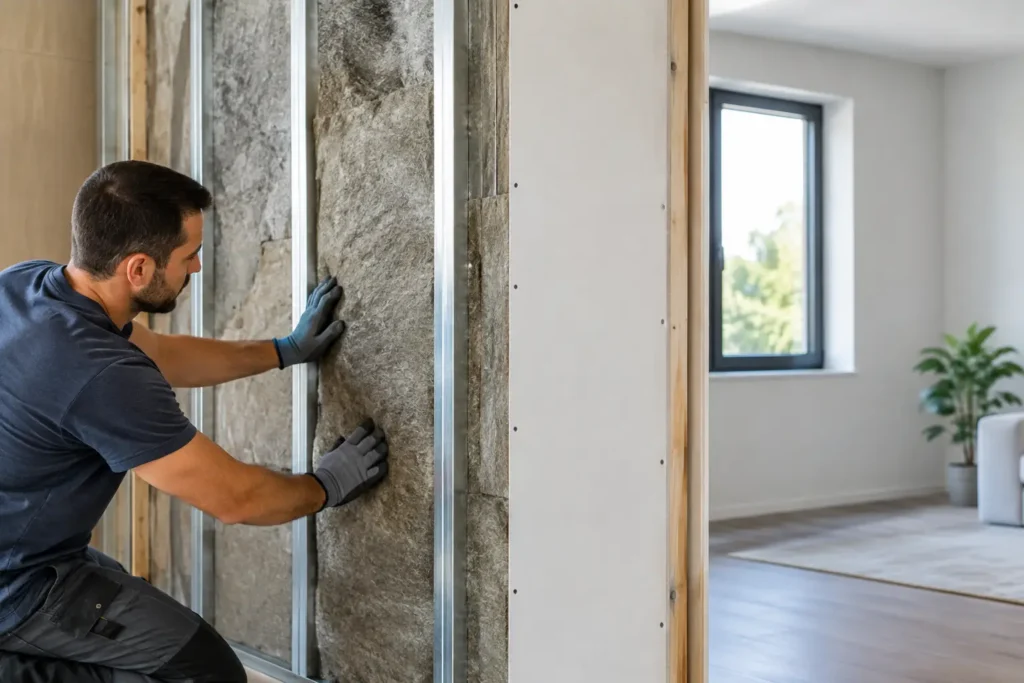
Fiberglass batts can provide some sound absorption, but mineral wool insulation is often a stronger choice for sound-rated wall assemblies. It is dense, fits securely between studs, and helps reduce sound movement inside the wall cavity.
Insulation does not stop sound by itself. Think of it as part of the assembly rather than the entire solution. A wall with mineral wool but gaps around outlets, ductwork, or drywall edges can still allow voices and noise to pass through.
Decouple the Wall Surface From the Framing
Sound vibrations travel through wood or metal framing. Decoupling helps limit that direct path. Depending on the project, a contractor may use resilient channels, sound isolation clips, staggered studs, or a double-stud wall.
These methods are not interchangeable. Resilient channel can be a cost-conscious upgrade when installed correctly. A double-stud wall provides much greater separation, but it takes up more floor area and costs more to build. For a tight ADU footprint, that lost space may matter. For a high-end rental or multigenerational unit, the added privacy may be well worth it.
Seal Every Gap
Sound travels through small openings with surprising ease. Proper acoustic sealant around wall edges, electrical boxes, plumbing penetrations, and framing transitions is essential. This work is not flashy, but it has a major effect on real-world performance.
A wall can look complete and still underperform if it has unsealed gaps behind baseboards, around recessed fixtures, or where a duct passes through. Careful installation matters as much as the materials selected.
Choosing the Right Wall Assembly for Your ADU
The best assembly depends on the level of privacy you expect, your budget, and whether the ADU is attached or detached.
For a detached ADU with no shared wall, standard framing with mineral wool insulation and well-sealed drywall may be enough for interior rooms. The priorities may shift toward exterior walls, upgraded windows, solid exterior doors, and placement away from noisy property lines.
For an attached ADU that shares a wall with the main house, consider a more substantial assembly. Mineral wool, two layers of drywall on one or both sides, and properly installed resilient channels can make a meaningful difference. This is a practical approach for homeowners who want better privacy without rebuilding the entire structure around a double-stud wall.
For an ADU designed for long-term rental, aging parents, adult children, or occupants with different schedules, a higher-performance assembly may make sense. A double-stud wall with insulation in both cavities, multiple drywall layers, and careful perimeter sealing provides stronger separation. It is an investment, but it can make the unit feel independent rather than connected by a thin partition.
Do Not Forget the Weak Points Around the Wall
A sound-rated wall can only perform as well as its weakest detail. Four areas deserve special attention during planning and construction:
- Doors: A hollow-core door can undermine an otherwise well-built wall. Solid-core doors, quality weatherstripping, and tight door sweeps help reduce sound leakage.
- Windows: Windows are usually weaker acoustically than a properly built wall. Their size, glass type, frame quality, and installation all affect noise control.
- Electrical boxes: Back-to-back outlets on opposite sides of a shared wall create an easy path for sound. Staggering boxes and sealing penetrations helps preserve the wall assembly.
- Ducts and vents: Shared HVAC paths can carry conversations and TV sound from one unit to another. Independent systems or properly designed ductwork can prevent this problem.
Ceilings and floors may also need attention. If noise can travel over, under, or around a wall, upgrading the wall alone will not fully solve the issue. This is called flanking noise, and it is one reason a complete site review is so valuable.
STC Ratings Are Helpful, but They Are Not the Whole Story
Sound Transmission Class, or STC, is a rating used to compare how well building assemblies reduce airborne sound. Higher ratings generally indicate better sound reduction. It is useful when comparing wall designs, but it should not be treated as a guarantee of complete silence.
STC testing does not fully capture low-frequency sound, such as bass-heavy music, rumbling vehicles, or some mechanical vibrations. It also cannot account for poor installation, gaps, or sound traveling around the wall through connected framing.
The practical goal is not always the highest possible rating. It is to build an assembly that fits how the ADU will be used. A homeowner renting to a tenant will likely want more separation than someone creating a private office or occasional guest suite. Clear expectations help guide the right investment.
Plan Sound Control Before Construction Begins
The best time to address noise is during design and framing. At that stage, it is easier to choose wall thickness, adjust room layouts, separate plumbing walls, and plan HVAC routes. Locating bedrooms away from shared walls can improve privacy without adding much cost.
If the ADU is already built, improvements are still possible. Adding a second drywall layer with damping material, replacing hollow doors, sealing gaps, and upgrading windows can help. Retrofit work is more limited than new construction, though, because the framing and hidden utilities are already in place.
A reliable contractor will look beyond a single product recommendation. The right approach considers the building layout, existing conditions, local code requirements, fire-rated assemblies where needed, and the level of privacy you expect from the finished space.
A well-built ADU should feel comfortable at all hours, whether someone is working early, putting a child to bed, or welcoming a new tenant home. Contact Greenwood Contractors for a free estimate and practical guidance on building soundproof ADU walls that fit your property and budget.